
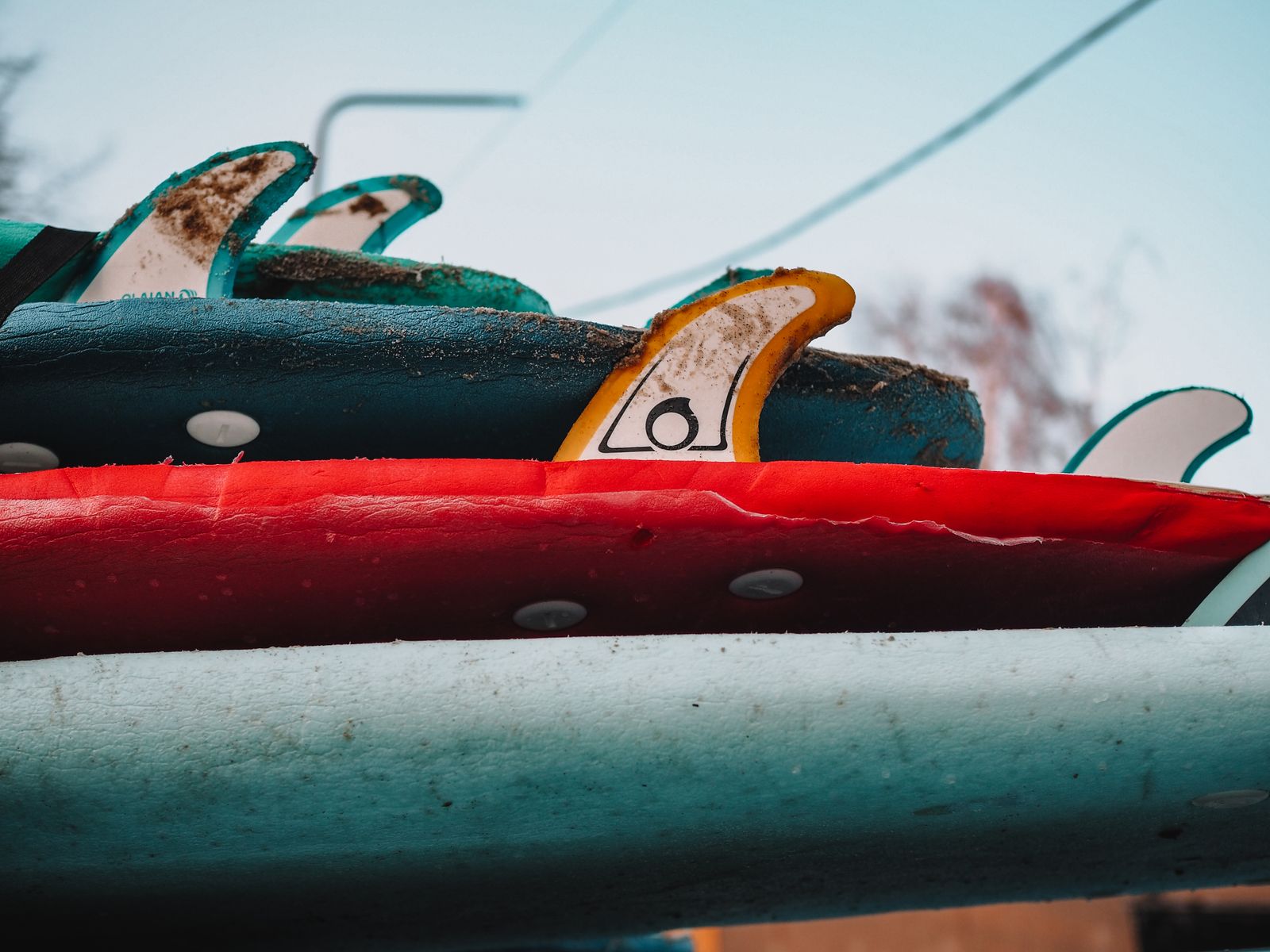
Sirip Surf Dijelaskan: Anatomi, Flex, Setup & Ukuran
Sirip adalah sistem kemudi papanmu. Referensi lengkap soal geometri sirip, flex, konstruksi, setup (single, twin, thruster, quad) dan cara menyesuaikan ukurannya dengan beratmu — lengkap dengan panduan cepat untuk setiap ombak Bali.
Fin adalah sistem kemudi papan selancarmu — ia menentukan dorongan (drive), daya cengkeram (hold), karakter belok, dan kecepatan. Bahkan perubahan kecil pada panjang, lebar, rake, atau flex secara signifikan dapat mengubah rasa papan di bawah kakimu. Panduan ini mengumpulkan setiap parameter, konstruksi, konfigurasi, dan ukuran fin di satu tempat, lalu merangkumnya menjadi bagan pilihan cepat yang bisa kamu gunakan sebelum sesi surfingmu berikutnya di Bali.
Bagaimana sebuah fin mengarahkan papanmu
Setiap fin dijelaskan oleh seperangkat nilai yang sama. Base, depth, dan rake bersama-sama membentuk 'plan shape' (outline dan area yang bisa kamu lihat); foil, cant, toe, dan flex mengontrol perilaku hidrodinamik yang kamu rasakan tapi tidak bisa lihat. Memahami tujuh parameter di bawah ini akan membuatmu bisa 'membaca' sebuah fin di toko, alih-alih cuma menerka-nerka.
1. Geometri Fin — tujuh parameter
Bentuk dasar (base, depth, rake, area) ditambah hidrodinamika tersembunyi (foil, cant, toe, flex).
| Parameter | Mengontrol apa | Pendek / kecil / tegak | Panjang / besar / miring ke belakang | Mempengaruhi |
|---|---|---|---|---|
| Base | Panjang fin di bagian yang menempel ke papan (titik terlebar) | Dorongan kurang, radius belok lebih ketat dan cepat | Dorongan dan kecepatan lebih, belokan lebih panjang dan mengalir | Dorongan |
| Depth | Jarak dari dasar ke ujung – seberapa dalam fin menancap di air | Lebih lepas, tail mudah 'membuang' (loose) | Daya cengkeram dan stabilitas lebih, 'terkunci' saat berbelok | Daya Cengkeram |
| Rake / sweep | Sudut/lengkungan yang mengarah ke belakang (ke arah tail) | Pivot ketat, reaktif (snappy) — bagus untuk ombak lemah dan berombak | Belokan panjang dan bertenaga — bagus untuk dinding ombak besar | Pivot |
| Area | Total permukaan dari base x depth x outline | Lebih lepas, lebih playful, lebih mudah bermanuver | Daya cengkeram dan kontrol lebih (ombak besar, peselancar berat) | Daya Cengkeram + Kontrol |
| Foil | Profil ketebalan dari tepi depan ke tepi belakang | Rata/asimetris (fin samping) untuk kecepatan dan tracking | Simetris 50/50 (fin tengah) untuk stabilitas arah | Daya Angkat |
| Cant | Sudut kemiringan fin samping dari posisi vertikal | 0 derajat / tegak untuk kecepatan dan dorongan lurus lebih baik | Cant lebih untuk rasa lebih responsif, tapi hambatan lebih besar | Respons |
| Toe | Seberapa banyak bagian depan fin samping mengarah ke tengah papan | Sedikit toe-in untuk kecepatan lurus lebih baik | Toe-in lebih untuk papan yang lebih mudah belok dan reaktif | Responsivitas |
| Flex | Seberapa banyak fin menekuk dan seberapa cepat ia kembali ke posisi semula | Fleksibel untuk rasa lepas, skatey, dan memaafkan (kehilangan kecepatan jika terlalu lembut) | Kaku untuk dorongan, stabilitas, dan proyeksi cepat keluar belokan | Kecepatan + Rasa |
Tips pro
Mengganti fin adalah 'papan baru' termurah yang bisa kamu beli. Sebelum kamu menjual papan yang sudah tidak sreg lagi, coba pasang set fin yang berbeda — fin yang lebih kaku dan tegak bisa benar-benar menghidupkan kembali shortboard yang terasa 'loyo'.
2. Flex dan Konstruksi
Flex sebagian besar ditentukan oleh materialnya. Dua hal yang penting: kekakuan (berapa banyak gaya yang dibutuhkan untuk menekuk fin) dan daya pantul (seberapa cepat fin kembali ke posisi semula). Fin yang kaku memberikan dorongan, daya cengkeram, dan prediktabilitas — ideal di ombak curam dan bertenaga. Fin yang fleksibel terasa lebih lepas dan playful, tapi akan 'membuang' jika terlalu fleksibel.
| Konstruksi | Flex | Karakter / Rasa | Ideal untuk |
|---|---|---|---|
| Plastik / Uretan (cetak injeksi) | Sangat fleksibel | Lembut, aman, murah, dan sulit patah — tapi kehilangan daya cengkeram dan 'membuang' | Soft-top, pemula, ombak kecil lembut |
| Komposit / serat kaca (contoh: GlassFlex, Thermotech) | Sedang | Konsisten, tahan lama, nilai bagus. Fin serbaguna yang solid | Pemula hingga menengah, ombak kecil hingga sedang |
| Fiberglass (lapisan tangan, dibentuk) | Sedang–kaku | Presisi, banyak dorongan dan daya cengkeram, sangat dapat diprediksi. Klasik performa | Pilihan standar, ombak sedang hingga besar |
| Performance core (inti honeycomb + serat kaca/karbon) | Disesuaikan | Ringan, hidup, flex yang disesuaikan dengan daya pantul cepat. Reaktif dan cepat | Performa tinggi, peselancar ambisius |
| Karbon (ujung atau full karbon) | Kaku | Ringan, sangat stabil, daya pantul cepat untuk banyak proyeksi dan dorongan | Ombak bertenaga, curam; surfing cepat dan agresif |
| G10 / Kayu (laminasi atau material alami) | Sangat kaku / flex klasik | G10: padat, kuat, daya cengkeram tinggi (keels, sidebites). Kayu: flex dan tampilan klasik | Fish dan keels (G10), single fin dan longboard (kayu) |
3. Konfigurasi Fin
Jumlah dan penempatan fin dapat mengubah bentuk papan yang sama persis. Aturan praktisnya: semakin dekat dan maju posisi fin, semakin lepas dan mudah bermanuver (ombak kecil); semakin jauh terpisah dan mundur posisi fin, semakin besar daya cengkeram dan stabilitasnya (ombak besar).
| Konfigurasi | Fin | Karakter | Kondisi ideal | Papan umum | Level |
|---|---|---|---|---|---|
| Single fin | 1 · besar, di tengah-belakang | Arc belokan mulus dan mengalir, banyak luncuran, hambatan rendah, stabil saat trim — lamban dalam belokan ketat | Ombak kecil–sedang dan panjang, rolling | Longboard / log, retro eggs | Semua · klasik |
| Twin | 2 · ukuran sama, di rail | Cepat, lepas, skatey, dan playful. Banyak kecepatan di ombak lemah — bisa lepas kontrol saat ombak besar | Ombak kecil–sedang | Fish, bentuk retro | Menengah · fun |
| Thruster (tri-fin) | 3 · ukuran sama | Patokan standar. Kontrol seimbang, dorongan dan pivot, sangat dapat diprediksi. Fin samping menambah daya angkat, fin tengah menstabilkan | Serbaguna; sangat bagus di ombak bersih dan bertenaga | Shortboard, hybrid, funboard | Pemula–pro |
| Quad | 4 · tanpa fin tengah | Cepat down-the-line, hambatan lebih sedikit, lepas seperti twin — tapi dengan kontrol lebih. Posisi cluster menentukan rasa | Ombak kecil 'mushy' ATAU barrel yang berongga dan curam | Fish, step-up, barrel board | Menengah+ |
| 2 + 1 | 1 fin tengah besar + 2 sidebites | Stabilitas single fin ditambah kontrol dan manuver ekstra dari sidebites. Hambatan lebih besar dibanding single fin murni atau thruster | Ombak kecil–sedang, bersih atau choppy | Longboard, egg, mid-length, SUP | Pemula–menengah |
| Twin + trailer | 2 + 1 trailer kecil | Kecepatan dan rasa lepas dari twin, ditambah trailer kecil di belakang untuk stabilitas tail ekstra | Ombak kecil–sedang | Fish / twinnies | Menengah+ |
| 5-fin box (konvertibel) | 5 box (tidak semuanya digunakan sekaligus) | Tidak ada konfigurasi tetap — lima box memungkinkanmu beralih antara twin, thruster, dan quad sesuai kondisi | Fleksibilitas maksimum untuk kondisi yang berubah | Shortboard, hybrid | Semua |
Konfigurasi mana yang sebenarnya cocok untuk Uluwatu vs Berawa vs Medewi adalah topik tersendiri — kami bahas secara mendalam untuk setiap jenis ombak di Bali dalam panduan khusus.
4. Ukuran berdasarkan Berat Peselancar
Faktor terpenting untuk ukuran fin adalah berat peselancar — itu menentukan beban yang harus ditanggung fin. Fin yang lebih besar berarti daya cengkeram dan kontrol lebih; fin yang lebih kecil terasa lebih lepas. Bagan FCS dan Futures tidak identik dan sengaja saling tumpang tindih. Jika ragu: peselancar bertenaga, ombak besar, atau tail lebar naik satu ukuran; tail sempit dan cepat turun satu ukuran.
Bagan ukuran FCS dan Futures sengaja saling tumpang tindih — gunakan sebagai rentang awal, bukan patokan mutlak.
| Ukuran | FCS (kg) | FCS (lbs) | Futures (kg) | Futures (lbs) |
|---|---|---|---|---|
| XS | hingga 55 | hingga 120 | 34–52 | 75–115 |
| S | 55–70 | 120–155 | 48–70 | 105–155 |
| M | 65–80 | 145–175 | 65–88 | 145–195 |
| L | 75–90 | 165–200 | 80+ | 180+ |
Tips pro
Box fin papanmu adalah FCS atau Futures — mereka tidak kompatibel satu sama lain. Periksa sistem apa yang digunakan papanmu sebelum membeli fin, dan bawalah kunci fin yang sesuai. Box fin yang longgar atau goyang pada papan bekas adalah perbaikan yang mahal, jadi selalu periksa sebelum kamu membayar.
5. Pilihan Cepat berdasarkan Kondisi Ombak
- KECIL / LEMBUT: twin atau quad, fin yang lebih kecil dan fleksibel dengan sedikit rake untuk kecepatan dan playful.
- BERSIH / BERTENAGA: thruster dengan kekakuan sedang untuk kontrol saat belokan dan bottom-turn.
- CURAM / BERONGGA / BARREL: fin kaku, dalam, dengan rake lebih; thruster atau quad di bagian luar belakang untuk daya cengkeram maksimum.
- PANJANG & ROLLING: single fin atau 2+1 untuk luncuran, trim, dan nose-riding.
Pilihan Cepat berdasarkan Tujuan Surfing
- KECEPATAN / ALIRAN: quad atau twin, fin tegak, cant sedikit, base lebih panjang.
- BELOKAN KETAT: fin tegak (rake sedikit), base lebih pendek, cant lebih untuk pivot.
- KONTROL / OMBAK BESAR: fin lebih besar, lebih dalam, lebih kaku; thruster untuk daya cengkeram dan prediktabilitas.
- PLAYFUL / LEPAS: fin lebih kecil, lebih fleksibel, lebih datar; twin atau quad dengan cluster maju.
Pilihan Cepat berdasarkan Level
- PEMULA: thruster (atau 2+1 untuk longboard), fin yang lebih besar/kaku untuk stabilitas.
- MENENGAH: sesuaikan fin dengan berat badanmu, flex sedang; mulai bereksperimen dengan twin dan quad.
- MAHIR: lakukan penyesuaian halus melalui flex, rake, dan posisi cluster dari sesi ke sesi.
Pilihan Cepat berdasarkan Jenis Papan
- SHORTBOARD: thruster atau box 5-fin (pilih thruster atau quad).
- FISH: twin, quad atau twin + trailer.
- MID-LENGTH: 2+1, thruster atau twin.
- LONGBOARD: single fin atau 2+1.
Fin juga berinteraksi dengan sisa quiver-mu — fin yang tepat untuk mid-length tidak ada gunanya jika volume papan tidak sesuai dengan levelmu, dan shortboard vs longboard mengubah segalanya tentang fin apa yang masuk akal.
Sebagian besar papan bekas di PASARA sudah termasuk fin — periksa foto dan deskripsi listingan, dan pertimbangkan satu set baru ke dalam anggaranmu jika finnya hilang atau sudah usang.
Pertanyaan yang Sering Diajukan
→Bagaimana cara memilih ukuran fin yang tepat untuk berat badanku?
Berat peselancar adalah faktor nomor satu — itu menentukan beban yang dibawa fin. Sebagai titik awal: di bawah 55 kg → XS, 55-70 kg → S, 65-80 kg → M, 75-90 kg → L. Bagan FCS dan Futures tumpang tindih dengan sengaja, jadi naik satu ukuran untuk surfing bertenaga, ombak besar, atau tail lebar, dan turun satu ukuran untuk tail sempit dan cepat.
→Apa perbedaan antara thruster dan quad di Bali?
Thruster (3 fin) adalah fin serbaguna yang seimbang — memberikan dorongan plus kontrol, dan sangat bagus di ombak bersih dan bertenaga seperti Uluwatu dan Bingin. Quad (4 fin) memiliki hambatan lebih sedikit dan kecepatan down-the-line lebih besar, jadi ia sangat cocok untuk hari-hari Canggu yang mushy maupun barrel yang berongga dan curam. Banyak peselancar Bali membawa satu set thruster untuk surfing harian dan satu quad untuk sesi kecepatan di sore hari yang glassy.
→Apakah fin FCS dan Futures bisa ditukar?
Tidak. FCS dan Futures adalah dua sistem box yang berbeda dan tidak kompatibel satu sama lain. Periksa sistem apa yang digunakan papanmu sebelum membeli fin, dan bawalah kunci fin yang sesuai. Pada papan bekas, selalu goyangkan box fin — box yang longgar atau goyang adalah perbaikan yang mahal.
→Apakah mengganti fin benar-benar membuat perbedaan?
Ya — itu adalah 'papan baru' termurah yang bisa kamu beli. Fin yang lebih kaku dan tegak menambah dorongan dan daya cengkeram pada papan yang terasa lamban; fin yang lebih kecil dan lebih fleksibel membuat papan yang terasa kaku menjadi lebih lepas. Sebelum menjual papan yang sudah tidak kamu sukai, coba set fin yang berbeda terlebih dahulu.
Tempat Berselancar
Spot yang disebutkan di panduan ini
Lanjutkan membaca
 Perawatan
Reparasi Ding di Bali: Di Mana Memperbaiki Papan dengan Cepat
Kena reef? Jangan panik. Ini decision tree antara perbaikan lapangan dan bengkel, dengan harga dan waktu Bali yang realistis.
 Perawatan
Teori Setup Sirip untuk Bali — Twin, Thruster, atau Quad?
Cara memilih sirip untuk variasi ombak Bali — reef cepat di Bukit, beach break lembut Berawa, dan semua di antaranya.
 Perawatan
Perawatan Leash, Wax Comb & Hal Kecil yang Selamatkan Sesi
Kebiasaan perawatan tak seksi yang bikin papan tahan 3× lebih lama di Bali — dan kenapa setiap traveler harus bawa leash string 50 sen.